In India the harmonium or reed-organ, or “the poor man`s pipe-organ,” belongs to the same family of instruments as the mouth-organs and accordion-type instruments. It has freely moving reeds (as well as rising reeds) on which a patent was taken out in 1840 by the French instrument maker, Alexandre Debain.
It became an extremely popular instrument in the United States and Europe in the second half of the nineteenth century, used mainly for accompanying the voice in the home and in church, since it had the tone of a pipe-organ without the bulk or the enormous expense.
The harmonium has a piano-like body which usually is elaborately carved in the fashion of the day. Harmonium has two foot-pedals connected to two bellows that provide air supply and keyboard has a range of five octaves. Below the keyboard there are two siphon paddles operated by the player`s knees. One initiates sort of swells mechanism while the other is used for musical emphasis like a general crescendo.
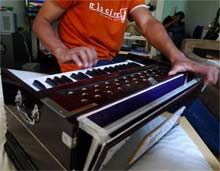
In India harmonium was introduced by the missionaries who brought these percussion instruments in the nineteenth century. Since then the instrument was portable and easy to learn an